The Authorship Transparency Statement (ATS) Framework
Generative AI has put creators into a strange corner.
Some audiences demand “purity tests” and treat any AI usage as a moral failure. Others celebrate full automation and dismiss questions of authorship as nostalgia. Meanwhile, most working creators are doing something far more ordinary: experimenting, integrating tools, iterating—trying to stay honest without getting dragged into a binary culture war.
And that is the real problem: our disclosure language is stuck at “yes/no”.
When someone asks “Did you use AI,” the question collapses wildly different processes into the same bucket. Using an AI to tighten wording is not the same as having an AI draft scenes. Yet both get treated as identical. That low-resolution framing encourages exactly the wrong incentives: honest people get punished for nuance, while deceptive people learn to hide behind ambiguity.
So the goal is not to defend or condemn AI.
The goal is to describe what happened—precisely enough that readers, publishers, and platforms can interpret it fairly.
That is what the Authorship Transparency Statement (ATS) Framework v1.0 is trying to do.
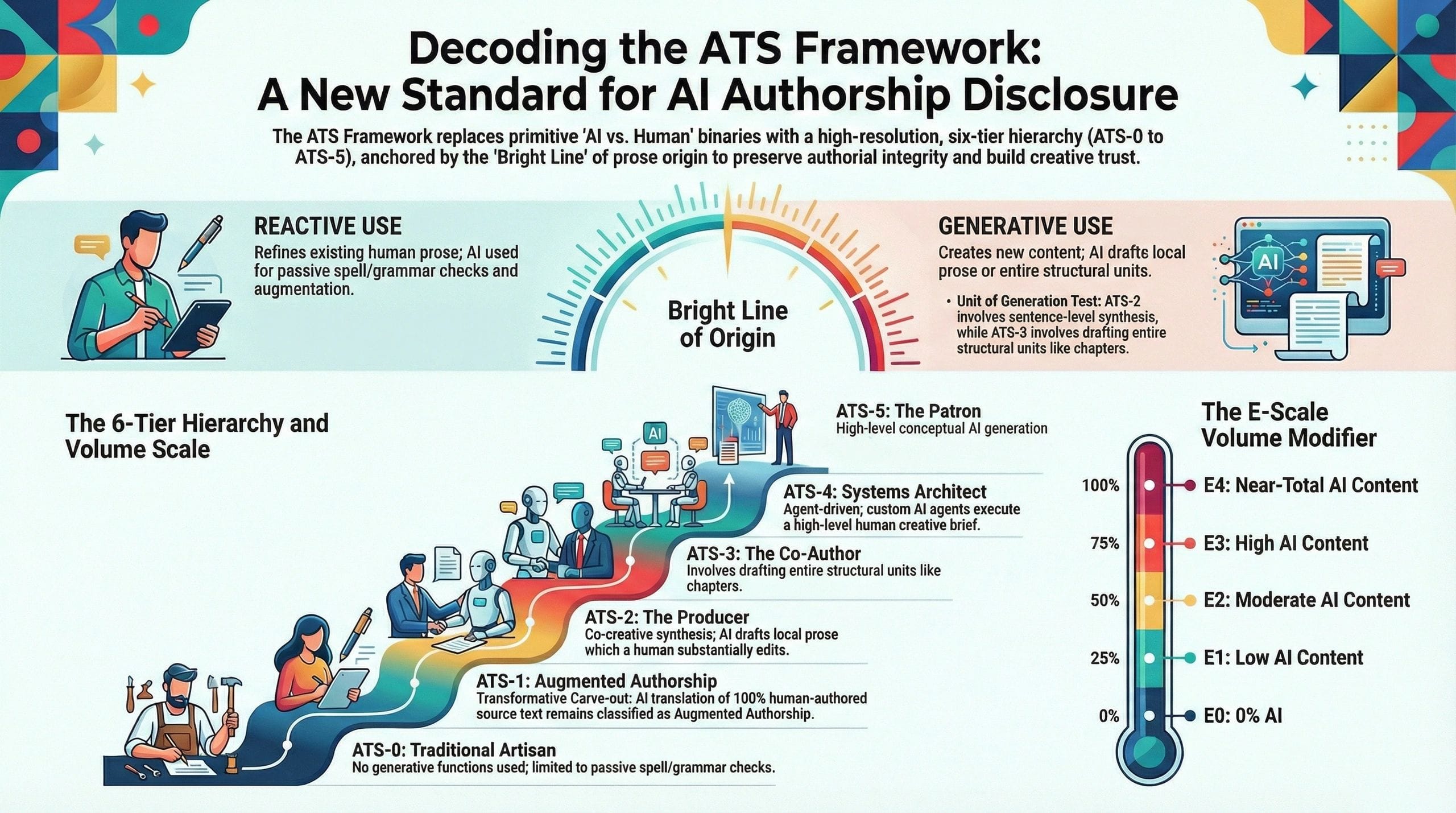
The single distinction that changes everything
ATS is built around one core idea: stop arguing about “creative control” and instead track something more concrete.
Where did the first complete draft come from?
That question draws a clean boundary between two fundamentally different kinds of AI usage:
- Reactive use: the human writes the prose first, and AI is used to refine, critique, translate, or assist without becoming the source of the initial draft.
- Generative use: AI produces the first-pass prose (even if the author later edits heavily). In that case, AI is part of the drafting layer, not merely a tool applied afterward.
This is the “Bright Line” the framework uses to bring clarity to discussions that are otherwise dominated by vibes and ideology.
A scale instead of a label
ATS avoids a single “AI-assisted” sticker. It introduces a tiered spectrum that maps how autonomous the AI’s contribution was, and what role the human played at each stage.
At one end are traditional workflows with no generative output. In the middle are co-creative processes where AI drafts fragments or larger units and the author synthesizes them into a final work. At the far end are highly autonomous pipelines where agents generate major components—or even the whole work—from a small human seed.
The point is not to rank these morally. It is to name them accurately.
Quantity matters too
Even with tiers, there is a second question readers will always ask:
“Fine—but how much of the work involved AI output?”
A single generated paragraph and half a book should not share the same disclosure label. So the framework includes an extent indicator: a simple way to communicate whether AI output was minimal, substantial, dominant, or near-total.
Put together, a disclosure becomes a compact statement that actually tells the truth of the process, e.g., a tier + an extent band.
Why this is pro-art, not anti-art
In an era of synthetic media and algorithmic distortion, trust becomes precious.
Transparency is not an attack on creativity. It is a defense against cynicism. It protects honest creators from being lumped in with misleading workflows, and it gives audiences a way to interpret what they are consuming without guessing.
ATS does not ask anyone to justify their process. It asks them to declare it in a standardized way.
That one change replaces suspicion with clarity.
Join the standardization effort
ATS v1.0 is published as a public proposal. The white paper is archived on Zenodo with a DOI, and the implementation materials (including machine-readable schema) are hosted on GitHub for community review and improvement.
- White paper: https://doi.org/10.5281/zenodo.18091713
- Repository: https://github.com/MeaningfulnessMediaGroup/
If you are a creator, publisher, platform builder, or standards body: adopt it, critique it, extend it. The binary era is over. We need a language that matches how creative work actually gets made now.
Djeff Bee Principal Architect, Meaningfulness Media Group
ATS Disclosure for this article: Text ATS-2 [E3]; Images ATS-5 [E4]; Research ATS-1 [E0]