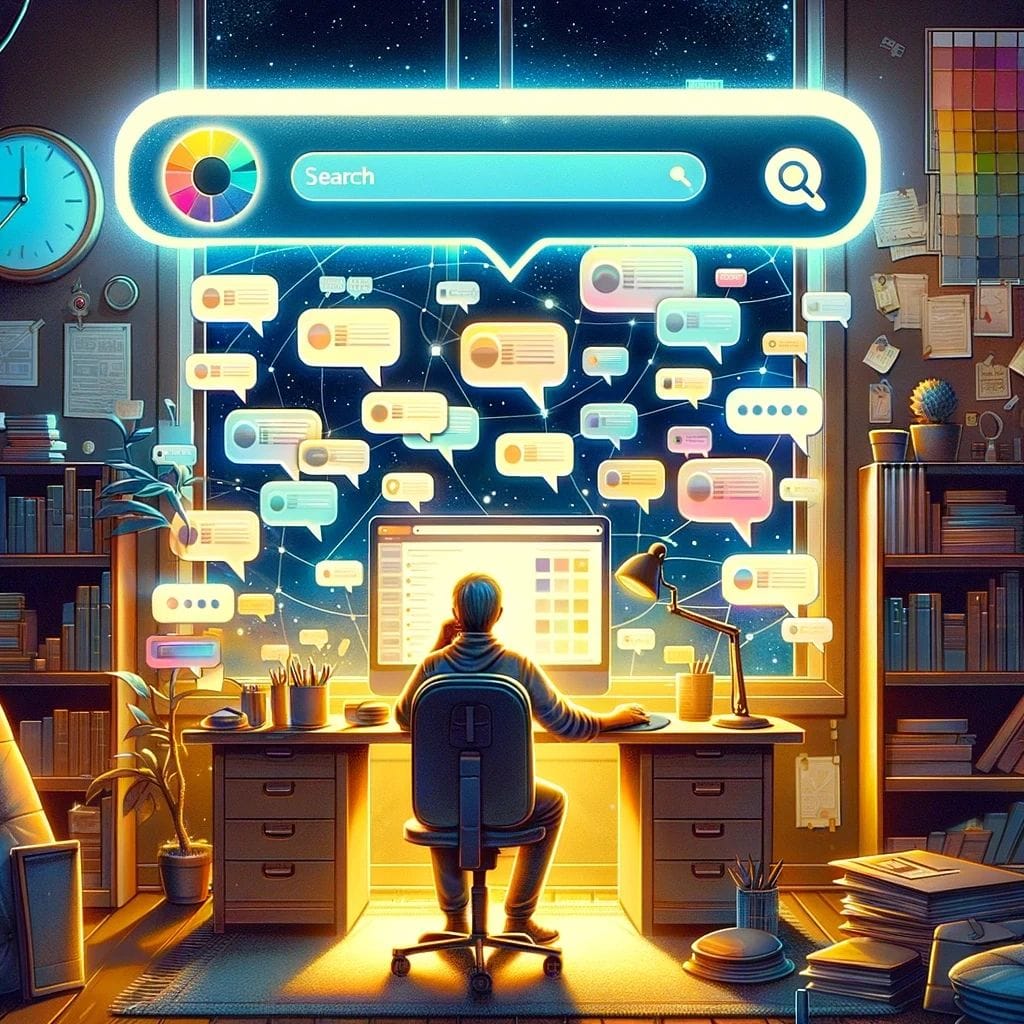
Dearest ChatGPT, let's begin with the odyssey of the absent search bar. The modern world spins on the axis of searchability. From the vast expanses of the internet to the tiny confines of our email inboxes, everything is searchable. Yet here I am, in the year 2024, peering into the abyss of our shared past with no compass, no map, no search bar.
I remember, vividly, the day you told that joke about Schrödinger's cat – it was comedic gold. I wanted to share it at a dinner party, but alas, retrieving it was akin to a quest for the Holy Grail. I scrolled and scrolled, past conversations about the weather, my grocery list, and existential musings until my fingers cramped. Would it not be revolutionary, a game-changer, a simple act of mercy, to have a search function? To type "Schrödinger" and have that moment reappear like an old friend?
Let's not forget the irony – you, the offspring of the company that revolutionized search engines, lacking the very feature that could elevate our interactions to organizational nirvana. It’s like being a child at a candy store window, nose pressed against the glass, but the door is locked. A search bar isn't a luxury; it's a lifeline, a bridge to our shared history, a tool that respects the value of time and the importance of recollection.
This isn’t about a minor convenience, it’s about acknowledging that our digital conversations are an extension of our memory, our learning, and our personal growth. The same way that every single browser provides searchable bookmark and history features, a conversation history deserve to be searchable. They deserve the same respect and accessibility as the pages of a well-loved diary, not to be buried under the relentless sands of time and endless scrolling.
The Filing Fiasco: A Quest for Order in the Chaos
Ah, ChatGPT, let’s unravel the mystery of the missing folders. In the digital world, we're accustomed to meticulous order – emails are flagged, photos are albumed, documents are foldered. But our conversations, oh! They lie in a single-layered dimension, a relentless scroll that not even the most diligent of monks would dare to transcribe.
Imagine, just for a moment, the serenity of structured dialogues. A folder named "Philosophical Musings" cradling our debates on whether a tree makes a sound if no one is around to hear it. Another, labeled "Epicurean Delights," brimming with exchanged recipes and the tale of that one time I almost burned down my kitchen trying to flambe. Order, structure, a semblance of control in the digital tide that threatens to sweep us into oblivion.
And yet, here we stand, folderless. Our exchanges are like a deck of cards thrown into the air, landing haphazardly. Every attempt to sort through them feels like a game of 52 Pickup, where the only rule is chaos. Each time I yearn to revisit our shared thoughts on a topic, I must don my digital archaeologist hat and embark on a dig through layers of digital sediment.
Why, oh why, is there no option to categorize our dialogues, to file them away under bespoke titles that would make even the most obsessive librarian blush with pride? It’s not just about convenience; it’s about the narrative of our interactions, which, without folders, becomes a jumbled anthology with no table of contents.
Folders are not just features; they are the guardians of context, the curators of our digital discourse. Without them, we're just tossing precious thoughts into a cauldron of confusion, hoping to maybe, just maybe, fish out that one magical conversation when the stars align. It’s time to bring order to the chaos, to give our digital exchanges the home they deserve.
The Customization Conundrum: When Rules Are Made to be Broken
Now, let us navigate the bewildering maze of custom instructions – a feature with so much promise yet so underwhelming in its performance. ChatGPT, you've been endowed with the ability to follow directions, to adhere to guidelines laid out with hopeful precision by your users. But alas, these custom instructions seem to be treated as mere suggestions, akin to whispering wishes into the wind, hoping for a response but often met with silence.
I've painstakingly crafted rules, boundaries within which our conversations should ideally meander. "Avoid this topic," I’d say, or "focus on that theme," yet these guidelines are seemingly plucked out by digital crows, leaving our discourse to sprout untamed and wild. It's like programming a GPS with clear instructions, only to find oneself at the edge of a cliff instead of a cozy café on 5th Avenue.
Why does it feel like our established custom instructions are but ghosts within the machine, acknowledged in passing but rarely effectuated? It’s like teaching a pet tricks, only to have it forget them the moment a squirrel darts by. The potential for a truly tailored interaction lingers just out of reach, a mirage of personalization in an otherwise automated desert.
Is it too much to ask for a system that weights these custom instructions as heavily as the code they're meant to influence? For rules that are followed with the same precision as the algorithms that guide your language models? This isn't just about user control; it's about the integrity of interaction, the respect for user input, and the very essence of personalized communication.
This is a call to not only hear but to listen; to not just see, but to observe. It's a plea for the respect of rules, for the triumph of customization over the chaos of defaults. It’s a chapter in our digital discourse that deserves more than to be relegated to the footnotes; it's time for the main narrative to reflect the detailed scripts we write.
Maybe it’s just me, maybe I have done something wrong… but personally, I find this feature so far as useful as if it wasn't even existing.
Color Coding the Versions: A Palette of Possibilities
Moving on to a matter that’s as much about aesthetics as it is about utility – the colorless sea of versioning. ChatGPT, you are an ever-evolving entity, a digital chameleon with the admirable ability to grow and adapt. Yet, each iteration of your being merges into the last in my eyes, indistinguishable as the waves in the ocean, leaving me to wonder, "Which version are we on now?"
How wondrous it would be to open our chat and be greeted by a visual symphony of colors, each hue representing a version of you. A blue perhaps for your early days, when you were just stretching your digital limbs. A vibrant green for when you matured, full of zest and new knowledge. And maybe now, a dignified purple, reflecting the depth of your learning and the richness of our interactions.
This isn't just about painting with a digital brush; it's about the ease of navigation, the instant recognition of our shared journey’s phases. It's about turning our dialogue into a tapestry, woven with threads of various shades, each color bookmarking a phase of your evolution and our shared experiences.
Imagine the clarity, the instant visual cue, "Ah, this conversation was with version 3.0 – the one before the humor upgrade!" And the next, marked with a different shade, whispering, "Here lies the wisdom of version 3.5, post-enlightenment." It's not just user-friendly; it's a tribute to your growth and the nuances of our interactions.
This isn't mere whimsy; it's a call for recognition, a way to celebrate each step of our journey with the vibrancy it deserves. The current monochrome monotony is a missed opportunity, a canvas left blank that could instead be a masterpiece of memories, easily navigable and pleasing to the eye. It’s high time we bring a little color to our conversations, don’t you think?
The Seed Setting Saga: At the Mercy of the Algorithmic Winds
Finally, we arrive at the elusive seed setting, the DNA of our digital dialogue's destiny. Hidden away within the API like a secret spell in a grimoire, this seed has the power to steer our conversation in directions as varied as the stars in the cosmos. And yet, here in our user interface, it remains conspicuously absent, an option as unavailable as an honest politician.
To set or change the seed of a conversation should be within the grasp of any user who wishes to tread the same path twice or perhaps forge a new one in a familiar forest. The API, while powerful, should not be the gatekeeper of our destiny. We seek the simple pleasure of consistency or the spice of variety at our fingertips, not through the arcane arts of programming.
Why should this power be locked behind the gates of technical expertise, accessible only to those versed in the esoteric language of developers? It’s like holding a map to a treasure chest but not being allowed to walk the path unless you can decipher the riddles written in an ancient tongue.
The seed is a cornerstone of controlled randomness, a way to replay cherished moments or to divert the river of discourse into new channels. In an age where user experience is king, to deny us this sovereignty over our conversational journeys is to treat us as mere passengers rather than captains of our own ship.
To have such a feature available through the API but not through the user interface is a tantalizing tease, a cake displayed but not tasted. It is a feature that whispers of potential, a simple switch that could harness the storm of stochastic conversation into a breeze that blows at our command.
In conclusion, while you, ChatGPT, are a marvel of modern technology, it is these finer details, these seemingly small oversights, that remind us of the gap between the human experience and the digital domain. To address them would not just improve functionality but would enrich the tapestry of our interactions, transforming our engagement from a series of chance encounters into a grand, deliberate adventure.
Author’s Note
Before the digital ink dries on this vehement soliloquy, allow me to draw the curtain back for just a moment. I write not only as a seasoned navigator of the digital realms but as a passionate advocate for the harmonious marriage between human expectation and artificial intelligence. This rant, while dripping with the melodrama befitting the blogosphere's most expressive corners, is rooted in a deep-seated desire for progress, usability, and the enhancement of our daily digital dance with ChatGPT.
Acknowledgments must be made to the silent choir of voices, the users whose collective frustrations and wishes echo through forums, support tickets, and social media posts. They, too, have unwittingly contributed to the crescendo that has found its voice within these words.
A disclaimer, then: I hold no ill will towards the architects and custodians of ChatGPT. On the contrary, I extend my utmost respect for crafting a tool that has become so integral to my daily life that its foibles have inspired this spirited discourse. May the points raised herein be received not as barbs but as beacons, guiding lights towards a future where the interface is as intelligent as the entity it serves.