The Gardener's Gambit
We are not only living through political turbulence, economic pressure, and ecological risk. We are living through something more subtle and, in some ways, more corrosive: a breakdown in how people form stable beliefs about reality.
Information is everywhere, constant, and relentless. We are flooded with clips, headlines, “receipts", leaks, outrage cycles, statistical claims, and algorithmic narratives that shift by the hour. At the same time, we are surrounded by misinformation, synthetic media, and strategic manipulation. The result is paradoxical: we have unprecedented access to facts, yet people feel increasingly disoriented—more anxious, more defensive, and less able to agree on what is real.
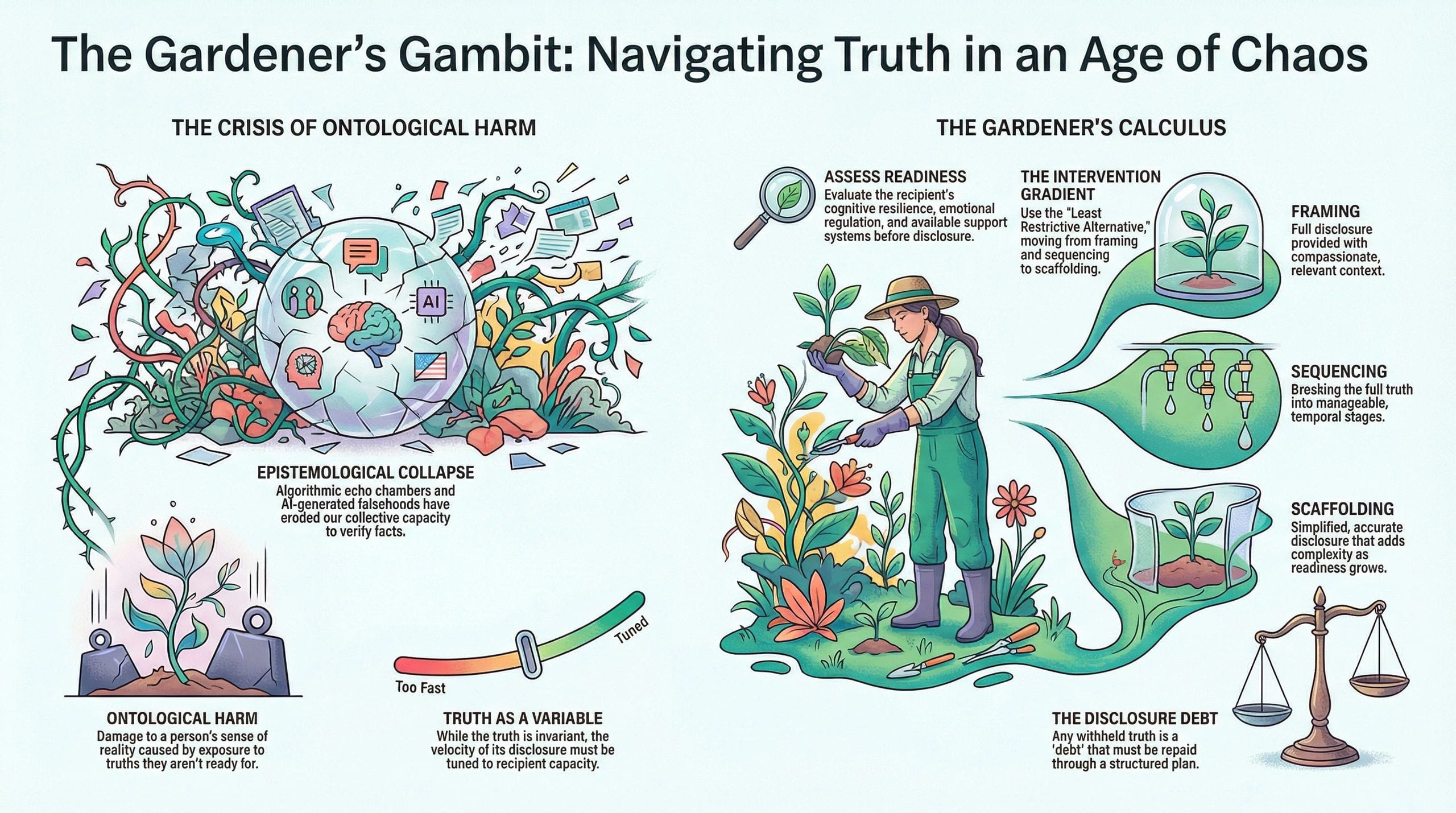
This is what I call an Epistemological Collapse: not merely “lots of lies", but a systemic erosion of shared methods for verifying truth and building meaning.
In that environment, the moral advice many of us inherited starts to fail. We grew up with slogans like “honesty is the best policy", and we often treat transparency as an absolute virtue. The assumption is simple: if you tell the truth clearly and directly, you are doing the right thing.
But that rule breaks under pressure.
Because there are truths that, when delivered without care, do not illuminate. They injure.
And there are contexts where “pure transparency" is not courage—it is negligence.
This is the gap Compassionate Logic is meant to address: a higher-resolution ethical framework for truth-telling in high-entropy, high-stakes environments.
The problem is not truth. The problem is impact.
There is a difference between “being correct" and “being responsible".
A person can be perfectly accurate and still cause damage if they deliver reality faster than the recipient can metabolize it. In other words, truth can arrive like a shockwave. And when it does, it can destabilize someone’s identity, safety, or psychological coherence.
That specific injury is what I call Ontological Harm.
This is not physical harm. It is not merely reputational harm. It is harm to a person’s relationship with reality—their sense of what is true, stable, and meaningful.
You have seen forms of it:
- A vulnerable person receives a worldview-shattering truth abruptly and spirals further into denial or paranoia rather than toward clarity.
- An employee learns a major life disruption through a cold message with no context, no support, no human containment.
- A child encounters the raw brutality of the internet before they have any scaffolding to interpret it safely.
In these cases, the truth is not “wrong". But delivered carelessly, it becomes something else: a force that breaks rather than builds.
The ethical failure is not that someone spoke honestly. The ethical failure is that they treated truth as if it were weightless.
Retiring “Brutal Honesty"
“Brutal honesty" often pretends to be virtue. But its most common function is simpler: it offloads responsibility.
It says: “I told the truth. What happens next is not my problem".
Compassionate Logic rejects that posture.
It argues that when you disclose high-impact truths—especially to a child, a partner, a team, or a dependent—you are not merely transferring information. You are intervening in someone’s mental world. And interventions have consequences.
So the question is no longer only: “Is it true?"
The question becomes: “What will this truth do to the person receiving it, given their current readiness and support?"
This is where a new role emerges.
The Gardener Archetype: Truth as Stewardship
A mechanic treats systems as machines: identify the fault, apply the fix, move on. That mentality works well for engines and code.
But human beings do not work like that.
A gardener knows you cannot force growth by pulling harder. You cannot strengthen a sapling by tearing away its shelter mid-storm. You cultivate conditions, you pace exposure, and you protect what is fragile until it is strong enough to stand.
Compassionate Logic argues that ethical truth-telling, in many real contexts, requires the gardener’s mindset.
That is the heart of the Gardener’s Gambit: the deliberate choice to temporarily shield someone from the full intensity of a truth for the specific purpose of building their capacity to face it later.
This is not deception as convenience. It is protection as responsibility.
And it comes with strict obligations.
Pragmatic Veracity: Truth, delivered at a human pace
Compassionate Logic makes a sharp distinction:
- Changing the substance of truth (deception), versus
- Managing the delivery of truth (stewardship).
The paper calls this Pragmatic Veracity: a commitment to truth that allows control over timing, framing, and velocity when the alternative would cause avoidable harm.
This matters because many people confuse “not saying everything instantly" with “lying". In practice, responsible communication often requires pacing, context, and containment—especially when the content is destabilizing.
But once you permit pacing, you must prevent abuse.
That is why Compassionate Logic is not just a vibe. It is a disciplined standard.
The three obligations of Compassionate Logic
1) Assessment before disclosure
Before you drop a major truth into someone’s life, you assess readiness:
- Do they have the emotional regulation to absorb this without collapsing?
- Do they have social support?
- Are they already under strain?
- Will this disclosure create more clarity—or more chaos?
If the likely harm is severe and immediate disclosure is not necessary for safety, then “truth right now" may be ethically wrong.
2) The Scaffolding Ladder and Disclosure Debt
If you choose to delay full disclosure, you incur a burden: Disclosure Debt.
You are not “done". You now owe the person preparation. You must actively build the internal scaffolding they lack—skills, resilience, context, and support structures—so the truth becomes survivable.
This is the shift from Oracle to Coach:
- An oracle drops information and walks away.
- A coach builds capacity so the person can carry reality without breaking.
3) The Sunset condition
No protective shield is allowed to last indefinitely. Every act of withholding must include a sunset condition: a time, milestone, or trigger that guarantees eventual disclosure.
Without that, “protection" quietly becomes control. And stewardship decays into manipulation.
Why this matters in the generative AI era
We are entering a period where fabricated “evidence" will be cheap, persuasive, and abundant. Video, audio, and images can be manufactured with realism that outpaces public literacy.
This creates two compounding dangers:
- Bad actors can generate convincing falsehoods at scale.
- Good actors can be dismissed, because everything can be labeled fake.
In that environment, ethical communication cannot rely on simplistic binaries. “Truth vs. lie" is too crude to navigate a world where context, readiness, and trust are under constant attack.
Compassionate Logic argues that stewardship outranks transparency.
Truth remains the destination. But care becomes the method.
The point is not to weaken truth. The point is to deliver truth in a way that builds human coherence rather than shattering it.
Want the rigorous protocol and tools?
This blog post is the accessible layer. The full work formalizes the ideas into a practical, auditable standard, including supporting artifacts.
- Read the white paper: DOI [10.5281/zenodo.18294160]
- GitHub Repository: https://github.com/MeaningfulnessMediaGroup/MMG-Gardener (Living Standard)