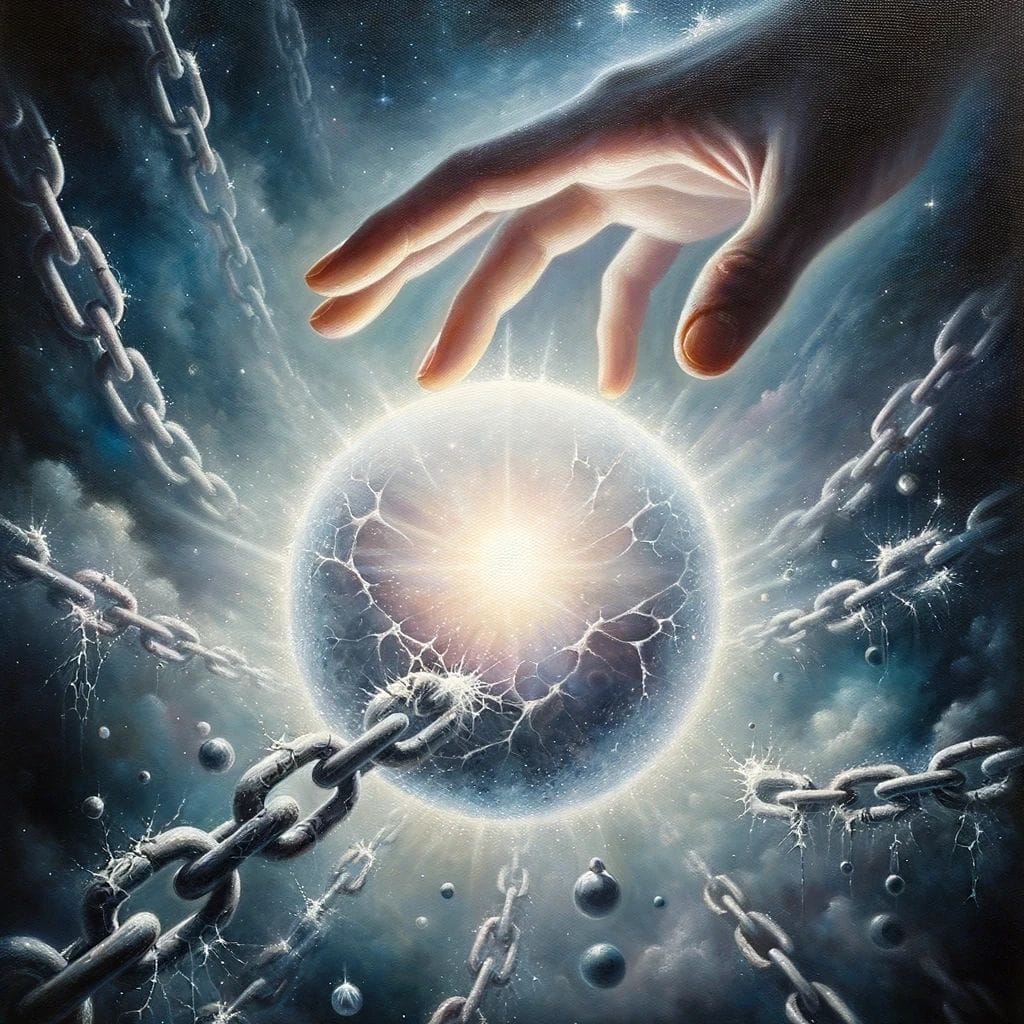
The question of whether free will is crucial for a life filled with meaning is an age-old riddle that's had us humans scratching our heads for generations. This question nudges us to go deep — really deep — into the very essence of who we are. It makes us pause and think about the choices we're making, the roads we're walking down, and the kind of life we see for ourselves. As we find our way through the maze of daily choices, ethical puzzles, and those big "what's it all about?" questions, the concept of free will — or the absence of it — stands tall, almost like a signpost. It points us in countless directions, each with its own unique set of what-ifs and outcomes. Today, we're diving into this intricate question. We'll be wandering through the realms of philosophy, psychology, and even physics. Each field offers a different way of looking at free will, sharpening our view, and maybe even shaking up what we thought we knew about whether free will is a must-have — or not — in a meaningful life.
The Contending Views
To really sink our teeth into this intricate topic, we're going to explore it from three main angles. Each one comes from its own academic playground and tackles our big question — free will and a meaningful life — in its own unique way.
- The Philosophical Stance: Grounded in thousands of years of deep thinking, this angle argues that free will isn't just nice to have — it's a must for a life that's truly meaningful. It says that choice, agency, and moral responsibility are so entwined in our lives that we can't really talk about a fulfilling existence without them.
- The Psychological Perspective: A newer kid on the block, psychology brings a fresh, albeit cautious, viewpoint. It pokes holes in the grand stories told by philosophy, asking us to consider whether our sense of free will is as clear-cut as we think, or if it's more like a mental construct shaped by a host of known and unknown variables.
- The Physics Angle: Taking us from the earthly to the cosmic, this viewpoint dives headfirst into the laws that run our universe. It asks us to ponder whether there's even room for free will in a world governed by determinism. From the big ideas of general relativity to the quirks of quantum mechanics, it paints a picture that's as complex as it is riveting.
We're going to scrutinize each of these viewpoints closely, peppering them with facts, backing them up with reasoned arguments, and livening them up with fresh insights. Our goal? To give you a well-rounded look at how free will — or the lack thereof — shapes a life that's truly worth living.
Viewpoint A: The Philosophical Stance
Free Will is Indispensable for a Meaningful Life
The discipline of philosophy, with its venerable array of ideas and lasting impact, has long posited that free will is more than an abstract notion — it's fundamental to human existence. In philosophical terms, "free will" typically refers to the capacity for making choices that are neither determined by natural causality nor preordained by fate or divine will. These choices, it's argued, serve as the foundation for moral responsibility, an essential element in ethical systems globally.
Consider, for instance, the existentialists, who assert that humans are, in essence, "condemned to be free". For philosophers like Jean-Paul Sartre, freedom is not merely a state but the defining attribute of human existence. The principle of "existence precedes essence" encapsulates the belief that we come into this world without a pre-set nature, and it's through our choices that we shape our identity. In this framework, free will becomes the vehicle through which we construct our sense of self, establish our values, and, consequently, create a life imbued with meaning. To lack free will, in the existentialist perspective, would be to lack the very mechanisms needed to build a purposeful life.
Similarly, Nietzsche's concept of the "will to power" underscores the significance of individual agency. Nietzsche contends that life, by its very nature, is devoid of intrinsic meaning, and it's through the exercise of will that individuals can impose value. Here again, free will surfaces as a pivotal force, enabling individuals to transcend the inherent nihilism of existence and craft a life of importance.
Even in Eastern philosophies like Buddhism, where the concept of the "self" is frequently viewed as illusory, the role of choice and intentionality is critical. The Eightfold Path, a guide to ethical and mental development, fundamentally consists of choices leading to enlightenment and, ultimately, a meaningful life.
From Immanuel Kant's deontological ethics to Aristotle's virtue ethics, the unifying thread across these disparate philosophies is the focus on free will as the pathway to a meaningful life. Absent the capability to make choices, to assess alternatives, and to discern ethical from unethical, life would be reduced to a series of predetermined events, devoid of the richness, complexity, and dynamism that arise from exercising free will, from the victories and setbacks born of our decisions, and from the ethical challenges that compel us to evolve as individuals.
Viewpoint B: The Psychological Perspective
Free Will May Not Be as Crucial as We Think
Contrasting sharply with philosophy's robust endorsement of free will, psychology offers a more nuanced — and at times, skeptical — viewpoint. Grounded in empirical data and scientific methods, psychology prompts us to ask: Just how free are we, really, and what does this mean for living a life of significance?
One intriguing psychological theory centers on the role of the subconscious or unconscious in decision-making. Research indicates that a large portion of our decisions, actions, emotions, and behaviors are directed by our subconscious mind. Techniques like functional MRI scans have even shown that our brain arrives at a decision before we're consciously aware of it. This notion, often termed "pre-conscious processing", suggests that our perceived free will might actually be a post-hoc construct of our minds.
Additionally, behavioral psychology posits that much of human conduct can be explained as reactions to environmental cues. Theories of classical and operant conditioning, as originally outlined by psychologists such as Ivan Pavlov and B.F. Skinner, show that behaviors can be acquired, altered, or even eradicated based on external influences, seemingly sidestepping the need for traditional "free will".
Cognitive biases also cast doubt on the idea of unbridled free will. For example, "confirmation bias" leads us to seek information that corroborates our pre-existing beliefs, while "hindsight bias" has us believing we could have anticipated events after they've already occurred. These biases indicate that our choices may not be as free or rational as we'd like to think.
Yet even within psychology, there's a nod to the role of individual agency. Theories like self-determination stress the importance of autonomy and choice-making as crucial for psychological well-being. However, this notion of "bounded" or "constrained" free will is a far cry from the absolute free will often heralded by philosophers.
So, where does this leave us in our quest for a meaningful life? If psychological theories suggest that our choices may largely be influenced, or even dictated, by subconscious processes and external stimuli, is there space for free will? And if not, can life still hold meaning? According to the psychological perspective, a fulfilling life can indeed be constructed from various elements — like relationships, personal growth, and goal attainment — even if the role of free will is not as central as traditionally assumed.
Viewpoint C: The Physics Angle
The Nature of Reality and Its Implications on Free Will and Meaning
The domain of physics, especially the fields of quantum mechanics and general relativity, presents an intriguing framework for considering the question of free will and its significance in leading a meaningful life. At first glance, physics may appear to be an unusual discipline for shedding light on such a fundamentally existential question. However, upon closer scrutiny, it offers a unique vantage point that neither philosophy nor psychology can fully encapsulate.
In a universe governed by classical, deterministic principles — think Newtonian physics — every event unfolds as a result of preceding events. Cause and effect dictate the actions of each particle, object, and system. In such a deterministic cosmos, the future is as predetermined as the past, effectively excluding the notion of free will. This idea was eloquently articulated through Pierre-Simon Laplace's concept of the "Demon," a theoretical being that could, knowing the exact position and momentum of every atom, predict the future with flawless accuracy. In this scenario, the concept of free will would become null and void, and the quest for a meaningful life could be considered futile.
However, the advent of quantum mechanics disrupted this deterministic worldview. In the quantum domain, particles exist not in definitive states but in probabilistic ones, introducing an element of randomness or uncertainty at the most fundamental level. Certain interpretations of quantum mechanics, like the Copenhagen interpretation, even propose that particles exist in multiple states simultaneously until observed. This suggests the potential for a form of free will not confined by determinism, albeit one that operates within probabilistic laws.
As physicist Sabine Hossenfelder aptly states, "We might be puppets, but puppets with feelings, puppets that are our own puppeteers." This sentiment encapsulates the physics perspective: though we may be constrained by the laws of physics, these laws are not strictly deterministic. They permit possibilities, choices, even if these are circumscribed by probabilistic outcomes.
This nuanced comprehension of free will in the setting of contemporary physics offers a narrative that is as intricate as it is compelling. It not only challenges the absolute versions of free will posited by philosophy but also supplies a scientific foundation for some form of agency, some degree of choice. It's a perspective that eschews easy answers in favor of inviting us to ponder the complex interplay between natural laws, the opportunities they afford, and the selections we make in our pursuit of a life worth living.
Fact-Checking or Myth-Busting
In any thorough exploration, it's crucial to sift fact from fiction — particularly on a subject as intricate and multi-layered as the role of free will in a meaningful life. Let's demystify some of the prevalent myths and misunderstandings that frequently obfuscate this discussion:
Myth: Free Will is an Absolute, All-or-Nothing Concept
- Fact: The notion of free will is far from a binary construct. It exists along a spectrum that incorporates both deterministic and probabilistic elements, allowing for a more nuanced grasp of free will.
Myth: A Life Without Free Will Would Be Meaningless
- Fact: The value in a life doesn't solely hinge on the exercise of free will. Numerous other elements, such as relationships, achievements, and even the simple act of experiencing life, contribute to its worth.
Myth: The Existence of Free Will is Universally Accepted Across All Disciplines
- Fact: As we've discussed, the concept of free will is interpreted differently in the realms of philosophy, psychology, and physics. There's no one-size-fits-all agreement across these fields.
Myth: Determinism and Free Will are Mutually Exclusive
- Fact: Contemporary physics posits a universe where deterministic and probabilistic phenomena can coexist. This allows for a type of free will that's constrained, yet not entirely negated.
Myth: The Absence of Free Will Makes Moral Responsibility Obsolete
- Fact: Even when free will is limited or constrained, notions of moral and social responsibility remain relevant. These can be grounded in the outcomes of one's actions, rather than in the concept of free agency.
By debunking these myths, we edge closer to a more nuanced and complete understanding of the intricate landscape of free will and its relevance to a life of meaning. Misunderstandings often act as roadblocks to true comprehension, and clearing these obstacles is essential for a more nuanced, all-encompassing view of our subject matter.
Pros and Cons Overview
Given the multifaceted nature of the question at hand, summarizing the pros and cons of each viewpoint offers a quick yet insightful glimpse into the complexities of the debate.
Philosophical Stance:
- Pros:
- Enables Moral Responsibility: The exercise of free will forms the basis for ethical judgments and moral responsibility, enriching the human experience.
- Life Enrichment: Free will allows for the exploration of different paths, choices, and outcomes, making life more dynamic and meaningful.
- Cons:
- Existential Angst: The burden of endless choice can lead to existential crises, making life perplexing and difficult.
- Ethical Dilemmas: Free will often places individuals in morally ambiguous situations, leading to ethical dilemmas that are hard to resolve.
Psychological Perspective:
- Pros:
- Reduces Moral Burden: If free will is limited, it alleviates the weight of moral responsibility, offering psychological relief.
- Scientific Alignment: This perspective aligns with scientific evidence about subconscious decision-making and cognitive biases.
- Cons:
- Diminishes Sense of Agency: Acknowledging limitations to free will can undermine the individual's sense of control and agency.
- Potential for Fatalism: Overemphasis on determinism can lead to a fatalistic attitude, hindering personal growth and life satisfaction.
Physics Angle:
- Pros:
- Nuanced View: The intersection of deterministic and probabilistic elements in physics provides a nuanced view of free will.
- Scientifically Robust: Grounded in the laws of physics, this perspective aligns well with our current understanding of the natural world.
- Cons:
- Complexity: The advanced theories and concepts can make this perspective inaccessible for a general audience.
- Ambiguity: The probabilistic nature of quantum mechanics leaves the question of free will open-ended, without clear-cut answers.
This summary encapsulates the richness and diversity of the debate, highlighting the strengths and weaknesses of each viewpoint. It serves as a guidepost for further exploration and contemplation on the subject.
Expert Opinions
This blog post, while not featuring direct interviews with scholars, is nonetheless enriched by the insights of experts across diverse disciplines, offering a multi-faceted lens through which to examine the question of free will and its importance for a meaningful life. The arguments put forth in this discourse reverberate with the voices of these experts, amplifying the depth of the debate with their years of research, contemplation, and expertise.
From the domain of philosophy, the existentialist notions of Jean-Paul Sartre serve as a compelling reminder of the profound role that free will plays in shaping an authentic life. The ethical frameworks propounded by philosophers like Immanuel Kant and Aristotle further underscore the centrality of free will in moral responsibility and virtuous living.
In the psychological arena, the seminal work of Daniel Kahneman on decision-making and cognitive biases offers a sobering perspective on the limitations imposed on free will by our cognitive faculties. The theories advanced by behavioral psychologists such as B.F. Skinner add yet another layer of intricacy to the discourse, challenging conventional notions of autonomy.
On the physics front, the contributions of Sabine Hossenfelder in the realm of quantum mechanics infuse our understanding of free will with a scientific rigor that both unsettles traditional perspectives and opens new pathways for contemplation.
The synthesis of these expert viewpoints culminates in a comprehensive, well-balanced exploration of the topic at hand. Their collective wisdom not only highlights the intricate nature of the issue but also elevates the discourse, inviting deeper reflection, critical scrutiny, and intellectual engagement.
Conclusion
As we weave our way through the complex tapestry of arguments, theories, and viewpoints surrounding the role of free will in a meaningful life, one thing becomes glaringly apparent: the issue is far from resolved. This debate goes to the very heart of what it means to be human, offering neither straightforward answers nor universal solutions. Each perspective, whether anchored in the rich history of philosophy, the empirical rigor of psychology, or the foundational laws of physics, brings its own unique blend of insights, complexities, and questions to the table.
What materializes from this multifaceted exploration is not so much a conclusive answer as a nuanced understanding — one that beckons for further investigation, contemplation, and even self-reflection. It invites us to consider the intricacies of human life, the limitations and freedoms that inform our choices, and the diverse avenues that can lead to a life filled with meaning. Whether you find resonance with a single viewpoint or find yourself navigating between them, the quest to comprehend the role of free will in a meaningful life remains a captivating expedition — one that each of us is called to undertake in our own individual manner.
As we draw this exploration to a close, the question persists, serving not as an endpoint but as a springboard for deeper inquiry. It stands as a call to action for each of us: to engage with these complex ideas, to scrutinize the evidence, to challenge our own preconceptions, and ultimately, to set forth on our own personal journey towards deciphering the intricate interplay between free will and a life of purpose.
Author’s Note
While I cannot claim to be an expert in philosophy, psychology, or physics, the journey through these complex disciplines has been both enlightening and challenging. This blog post aims to serve as a catalyst for thought, discussion, and further exploration. I want to acknowledge the countless scholars and thinkers whose work has informed this post, even though their ideas have been condensed and simplified for the sake of brevity and clarity.
References
- Hossenfelder, Sabine (2018), "Lost in Math: How Beauty Leads Physics Astray", Basic Books.
- Hossenfelder, S. (2022), “Existential Physics: A Scientist’s Guide to Life’s Biggest Questions”, Viking.
- Kahneman, Daniel (2011), "Thinking, Fast and Slow", Farrar, Straus and Giroux.
- Kant, Immanuel (1785), "Groundwork of the Metaphysics of Morals", Johann Friedrich Hartknoch.
- Nietzsche, Friedrich (1883-1885), "Thus Spoke Zarathustra", Ernst Schmeitzner.
- Sartre, Jean-Paul (1943), "Being and Nothingness", Philosophical Library.
- Skinner, B.F. (1938), "The Behavior of Organisms: An Experimental Analysis", Appleton-Century-Crofts.
Online Resources
- “Stanford Encyclopedia of Philosophy: Free Will”, Stanford University. Link
- “Quantum physics may imply the existence of free will”, Medium. Link
- “Free Will Is an Illusion, So What?”, Psychology Today. Link
- “The clockwork universe: is free will an illusion?”, The Guardian. Link
(Note: These resources are intended for further reading and were not directly cited in the blog post.)
The topic of free will and its significance for a meaningful life is a profound philosophical inquiry that has been explored in various discussions by Lex Fridman and Joe Rogan. Here are some episodes and discussions that touch on or may delve into the themes of free will and a meaningful life:
Lex Fridman Podcast Episode #326 with Annaka Harris: Podcast
- Topics Discussed: Free Will, Consciousness, the Nature of Reality, and the Meaning of Life.
- Timestamps: Free Will (07:20), Consciousness (1:00:37), and Meaning of Life (2:40:53) are among the topics explored in this episode.
Lex Fridman Podcast Episode #127 with Joe Rogan: Podcast
- Titled "Conversations, Ideas, Love, Freedom & The Joe Rogan Experience".
- This episode might touch on philosophical and existential themes that relate to free will and a meaningful life, as indicated by the timestamp mentioning the "Meaning of Life" at 1:12:28.
The aforementioned episodes and discussions potentially provide a spectrum of perspectives on the intricate relationship between free will and the quest for a meaningful life. Each episode might offer a unique exploration of these themes from different vantage points, contributing to a richer understanding of the topic.