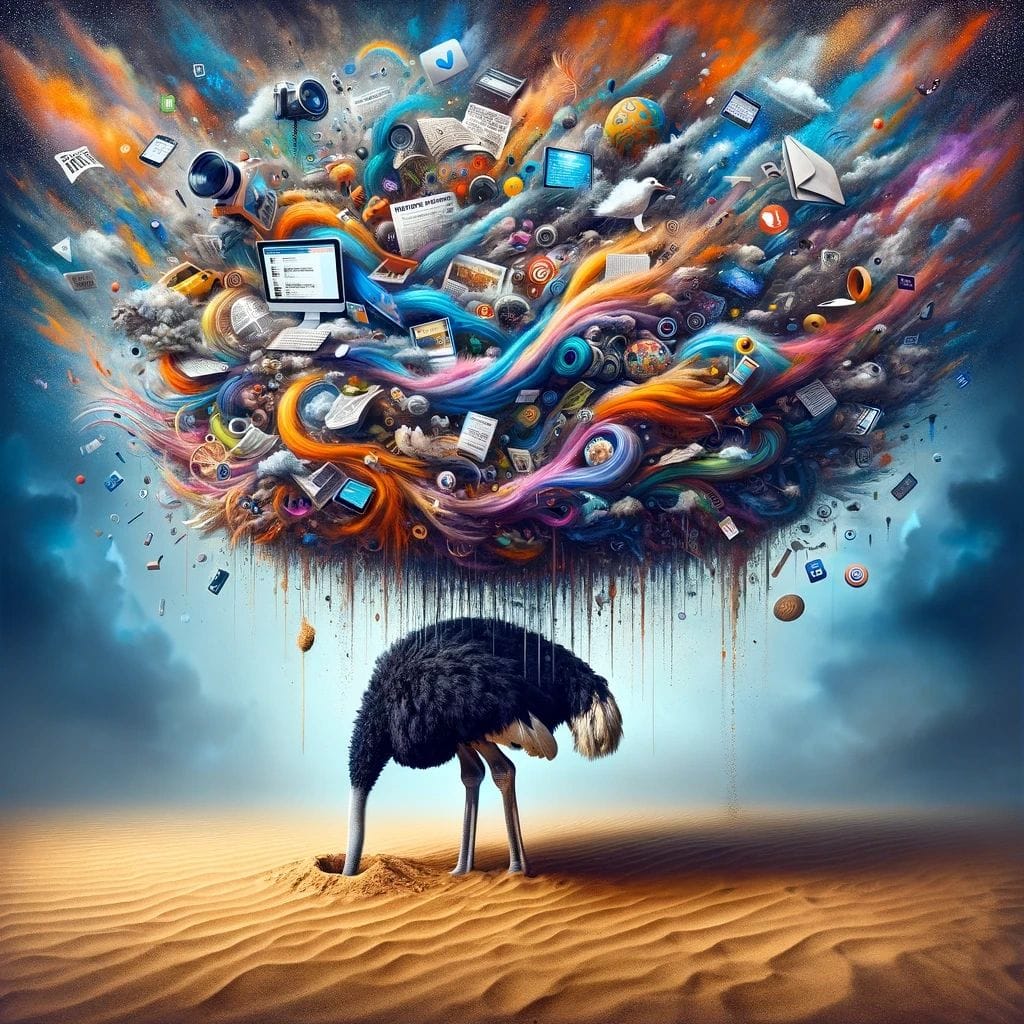
In the labyrinth of the modern world, where every turn offers a new piece of information, a new headline, or a new narrative, one can't help but feel overwhelmed. It's a torrential downpour of data, cascading through the screens of our smartphones, the pages of our newspapers, and the conversations of our social circles. This information age, often celebrated for its promise of connectivity and enlightenment, carries a lesser-discussed burden: the emotional toll of constant awareness.
For every groundbreaking scientific discovery that uplifts us, there are multiple stories of political chaos, social injustice, and environmental degradation that drag us back down. It's as if we're on an emotional seesaw, oscillating between fleeting moments of joy and prolonged periods of despair. The very tools that were designed to enlighten us have also inundated us with so much that is disheartening. And it's not just about the volume; it's about the nature of the news we receive, which often highlights conflict, disaster, and suffering.
This poses a significant challenge for our emotional and psychological well-being. Every time we unlock our phones or open a web browser, we're playing Russian roulette with our mental state. Will it be a story about a community coming together that uplifts our spirits, or will it be a harrowing tale of loss that plunges us into anxiety? Often, it's the latter, and the cumulative effect of such exposure can be paralyzing.
The weight of the world's problems, magnified through the lens of the media, becomes a heavy load to carry. And it's a load that we bear not just cognitively, but emotionally. How do we navigate this emotional landscape without losing ourselves in it? How do we stay informed without becoming emotionally drained? It's a complex dilemma, one that invites us to explore the merits and drawbacks of two divergent paths: the path of ignorance and the path of awareness.
The Argument for Ignorance: A Peaceful Mind
Why Ignorance Can Be Bliss
Ignorance, often maligned as a sign of naivety or lack of awareness, holds an unspoken allure—peace of mind. Imagine a life where the ceaseless drumbeat of distressing news doesn't reverberate through your day. Your mornings start with the aroma of freshly brewed coffee, not the acrid sting of the latest international crisis. The conversations you engage in revolve around personal growth, art, and the simple joys of life, rather than the impending sense of doom that often accompanies discussions about current events.
In such a world, your emotional reservoir remains largely untapped by external circumstances, allowing you to channel your energies into creativity, relationships, and personal development. Without the cloud of global suffering hanging over you, the sun seems to shine a little brighter, the air feels a little fresher, and life's simple pleasures become more enriching.
This form of ignorance is not about a lack of intelligence or an unwillingness to engage with the world. It's a selective focus, a conscious decision to shield oneself from the emotional turbulence that can accompany too much awareness. It's a protective cocoon that insulates you from the anxieties and existential dread that often come with knowing too much.
The Emotional Cost of Awareness
Yet, the bliss of ignorance is not without its price. There is an emotional cost to being constantly exposed to troubling information, a cost that manifests as a constant background noise of anxiety, like a radio playing just out of earshot. This is the sound of our emotional bandwidth being consumed by issues that we have little or no control over. The crises in far-off lands, the political turmoil brewing in distant capitals, and the environmental disasters that we read about all siphon off a part of our emotional energy.
Our minds are not limitless vessels; they have a finite amount of emotional and cognitive resources. When those resources are continually allocated to processing distressing information, it leaves us with less energy for our own lives. Activities that should be joyous can become chores when viewed through the lens of global suffering. Personal challenges can seem insignificant, almost trivial, when stacked against the backdrop of collective hardship, leading to a form of guilt that further drains our emotional resources.
The Limitations of Control
But perhaps the most insidious emotional cost comes from the realization of our own limitations. We live in an age that glorifies control, where the narrative of the self-made individual pervades our culture. And yet, the more we are exposed to the complexities of the world, the more we come to understand the limits of our influence.
For every petition signed, every voice raised, and every act of kindness, there are systemic issues that remain largely unchanged. The scale of the problems can make our individual contributions feel like mere drops in an ocean, leading to a sense of futility. This is the emotional burden of awareness: the weight of knowing that despite our best efforts, there are forces in the world, vast and complex, that remain beyond our control.
The existential weight of this realization can be crushing. It challenges our perceptions of efficacy and purpose, leading us to question the significance of our actions. In the grand tapestry of global events, do our individual threads even matter? This question, born from a heightened sense of awareness, can lead us down a path of emotional fatigue and existential questioning.
The Argument for Awareness: A Compassionate Soul
The Role of Empathy
Yet, despite the emotional pitfalls that accompany constant awareness, there is an invaluable gem to be found: the cultivation of empathy. Empathy is not merely the ability to understand another's perspective; it's the ability to share in their emotional experience, to feel what they feel. Empathy is like a bridge, a connective tissue that links us to the emotional worlds of others.
When we read about a refugee crisis or witness the aftermath of a natural disaster, we are not merely processing facts and figures; we are engaging our empathic faculties. We are stepping into the shoes of the suffering, if only for a brief moment, and gaining a glimpse into their emotional landscape. This experience, while emotionally taxing, can be transformative. It pushes us to transcend the boundaries of our individual selves and participate, however vicariously, in the collective human experience.
This ability to feel deeply for others, even those far removed from our immediate lives, is not just an emotional skill but a moral one. It challenges us to extend our circle of moral concern beyond our immediate community and even our species. It's a skill that calls us to be better, not just for ourselves but for the broader tapestry of life in which we are but a single thread. The cultivation of such emotional intelligence, akin to the ideas put forth in the exploration of empathy in "The War for Kindness", by the psychologist Jamil Zaki, enriches our lives in profound ways. It equips us with the emotional tools to navigate a world that is increasingly interconnected and interdependent.
The Potential for Collective Action
Moreover, being attuned to the suffering and challenges of others opens the door for collective action. The notion that we are powerless as individuals is partly a narrative trap. While it's true that the scale of many global issues dwarfs individual action, there's a caveat: systemic change often starts at the grassroots level. It begins with conversations, awareness, and small acts of kindness that ripple outwards. A single voice may not be able to enact policy change, but a chorus of voices, harmonized by shared values and concerns, can be a potent force for social transformation.
The very awareness that we may find emotionally draining is the same awareness that can galvanize communities, fuel social movements, and drive systemic change. It's a paradox of sorts: the emotional weight of awareness is both a burden and a catalyst, a challenge and an opportunity.
Navigating the Emotional Landscape
Indeed, awareness brings with it a complex emotional landscape that requires careful navigation. It presents us with emotional valleys and peaks, moments of despair and inspiration. Yet, this emotional complexity is not something to be avoided but embraced. It's an invitation to engage deeply with our emotional selves, to understand the triggers and levers that govern our emotional states.
Emotional intelligence involves not just empathy but self-awareness. It's about recognizing our own emotional limits and learning how to replenish our emotional reservoirs. Whether it's through mindfulness practices, physical exercise, or meaningful interactions with loved ones, there are ways to recharge emotionally, even in the face of overwhelming awareness.
This is not about detaching ourselves from the world but about engaging with it sustainably. It's about finding that delicate balance where we can be both informed and emotionally resilient, aware yet not overwhelmed. It's a challenging balance to achieve, but it's a necessary one if we are to navigate the emotional complexities of the modern information landscape.
Striking a Balance: The Middle Ground
Limiting Exposure
The tug-of-war between the emotional tranquility of ignorance and the moral imperative of awareness leaves us at a crossroads. Do we shield ourselves for the sake of emotional well-being, or do we embrace the emotional complexity that comes with being informed? The answer, perhaps, lies in a middle ground: a selective engagement with the world around us.
In this digital age, we often forget that we have agency over the information we consume. The algorithms may suggest content, but we make the final decision to click or scroll past. By being discerning about our information diet, we can achieve a semblance of balance. Limiting our exposure to distressing news doesn't mean being uninformed; it means being selectively informed. It involves curating our information streams so that they align not just with our intellectual interests but also with our emotional capacity.
Emotional Self-Care
Self-care is often framed in the context of physical health —exercise, diet, sleep— but what about emotional self-care? Just as we wouldn't expect to run a marathon without adequate training, we shouldn't expect to navigate the emotional marathon of modern life without preparation.
This preparation involves understanding our emotional triggers and creating spaces where we can recharge. It could be a weekly digital detox, a daily meditation session, or even something as simple as spending quality time with loved ones. These acts of emotional self-care provide us with the resilience to face the emotional complexities of the world without becoming consumed by them.
Active Engagement
But perhaps the most empowering approach to balancing emotional health with social awareness is active engagement. This goes beyond merely consuming information to interacting with it. It involves diving deeper into the issues that resonate with us, seeking out diverse perspectives to enrich our understanding, and considering actionable steps we can take, however small.
Active engagement transforms us from passive consumers of information into active participants in the world. It provides us with a sense of agency, a feeling that we are not just helpless spectators but engaged citizens. Whether it's joining a community organization, participating in a protest, or even engaging in thoughtful discussions, active engagement provides an emotional outlet for the awareness we carry. It allows us to channel our emotional responses into constructive action, providing a sense of purpose that can be emotionally rejuvenating.
In a world teeming with challenges, finding this middle ground enables us to be both emotionally stable and socially responsible. It empowers us to be agents of change without becoming casualties of emotional exhaustion.
Conclusion: A Personal Journey
Life, in its essence, is a journey through an ever-changing landscape of experiences, emotions, and understandings. The path between ignorance and awareness is not a straightforward one; it's a winding road with its own set of challenges and rewards. It is a journey that requires us to continually reassess our emotional boundaries and moral commitments.
The decision to remain ignorant or to embrace awareness is not a one-time choice but an ongoing process. It is a dynamic equilibrium that adjusts to the evolving contexts of our lives. There will be phases where the emotional burden of awareness becomes too much to bear, necessitating a retreat into the sanctuary of selective ignorance. Conversely, there will be times when the moral imperative of awareness calls us to engage deeply with the world, despite the emotional costs.
This is not a journey we undertake alone. We are part of a broader social fabric that influences and is influenced by our choices. Our individual decisions to engage or disengage resonate through our social circles, subtly shaping the collective consciousness. It is a journey that intertwines our individual emotional well-being with the collective well-being of our communities.
So the next time you find yourself overwhelmed by the barrage of information, or disheartened by the seemingly insurmountable challenges of the world, remember this: You have agency. You have the power to choose how you engage with the world, how you navigate the intricate dance between emotional self-preservation and moral responsibility.
In this balancing act, there are no easy answers, only choices that come with their own sets of challenges and rewards. But it's in making these choices that we grow, both as individuals and as members of a larger community. It's in this delicate balancing act that we find our purpose, our resilience, and ultimately, our humanity.
The journey between ignorance and awareness is a personal one, but it's also universally human. It reflects the broader struggle to find meaning and balance in a world that often seems chaotic and overwhelming. But it's a struggle worth engaging in, for it shapes not just who we are, but who we have the potential to become.
Author's Note
I am an individual deeply passionate about understanding the emotional and psychological complexities of human life. My journey through the labyrinth of modern information has led me to explore the intricate balance between emotional well-being and social responsibility. While I don't claim to have all the answers, I believe that dialogue and introspection are crucial steps in navigating this complex landscape. I want to acknowledge the emotional labor that goes into staying aware and empathetic in today's world, and commend each one of you who engages in this difficult yet rewarding journey.
References
- Zaki, J. (2019), "The War for Kindness: Building Empathy in a Fractured World", Crown.
- Rogers, C. R. (1961), "On Becoming a Person: A Therapist's View of Psychotherapy", Houghton Mifflin.
- Gandhi, M. K. (1954), "The Collected Works", Publications Division, Ministry of Information and Broadcasting, Govt. of India.
Online Resources
- "The Cost of Caring: An Exploration of Compassion Fatigue", NCBI, National Library of Medicine. A research article examining the emotional toll of empathic engagement. Link
- "Digital Detox: How and Why to Recharge Your Mind", The Beacon by Luminis Health, Behavioral Health. An online guide providing practical tips for emotional self-care in the digital age. Link
In closing, the resources and references presented in this article are a curated selection that I find particularly insightful for understanding topics ranging from empathy and emotional intelligence to the complexities of our modern world. However, this list is by no means exhaustive. Given the multi-dimensional nature of these subjects, there exists a plethora of additional books, articles, and multimedia content that offer varied perspectives and deeper insights. I encourage you to broaden your exploration beyond this list to fully engage with the rich tapestry of ideas that these fields offer.