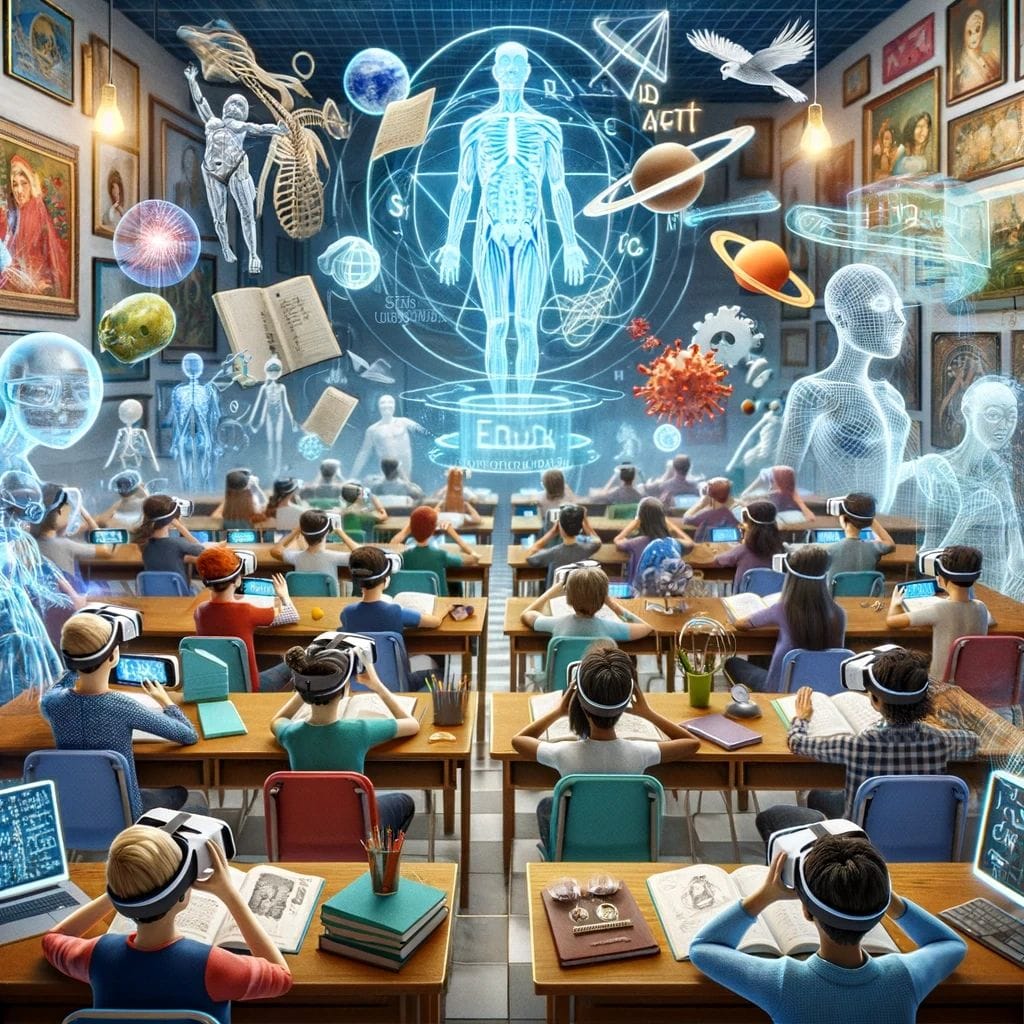
In the ever-evolving landscape of educational technology, Virtual Reality (VR) stands out as a transformative force, offering an immersive learning experience that is both engaging and effective. VR has the potential to revolutionize teaching and learning processes by providing a three-dimensional, interactive environment where theoretical knowledge is brought to life through practical, hands-on simulations.
The Immersive Edge of VR in Learning
Virtual Reality (VR) in education marks a significant leap from traditional teaching methods, inviting students into a dynamic world where learning is not just seen but experienced. Imagine stepping into the Colosseum at the height of the Roman Empire, or shrinking down to explore the intricate lattices of a carbon molecule — all from the comfort of a classroom. This is the immersive edge that VR provides: a sensory-rich environment where education takes on a new dimension.
Interactive Simulations and Experiments
With VR, science classrooms are no longer confined to textbooks and static images. Students can engage in interactive simulations that bring complex concepts to life. For example, medical students can perform intricate surgeries in a risk-free virtual space, gaining valuable practical experience. In the field of physics, learners can experiment with gravity, momentum, and other principles by manipulating variables in a virtual environment, witnessing the immediate impact of their actions.
These simulated experiences are not mere visual aids; they are robust educational tools that foster deep learning. They allow for immediate feedback and the chance to repeat procedures or experiments multiple times, which is instrumental in mastering difficult concepts. By making the abstract tangible, VR helps to solidify students' understanding in a way that traditional methods might struggle to achieve.
Global Exploration and Historical Reenactment
Beyond the sciences, VR's potential for exploration is boundless. It offers history students a time machine of sorts, enabling them to witness the construction of the Pyramids or to stand among the crowd during the Gettysburg Address. Geographical boundaries dissolve as students teleport across continents, exploring the Amazon rainforest or the icy expanses of Antarctica. Each journey is a lesson in culture, history, and geography, delivered in an unforgettable format that resonates with the voyagers.
Historical reenactments in VR provide an emotional resonance with the past. When students can observe the events leading up to the American Revolution or walk the streets of ancient Athens, history is no longer a list of dates and events—it becomes a lived experience. This deep emotional engagement can inspire a passion for learning that transcends the traditional classroom setting.
Language Learning and Cultural Immersion
Language acquisition through VR is uniquely impactful. It immerses learners in the nuances of language and culture in ways that audiobooks and flashcards cannot. Students can practice speaking with native speakers in simulated real-world scenarios, from ordering food in a Parisian café to haggling in a Middle Eastern souk. These immersive dialogues enhance linguistic competence and cultural understanding, preparing students for real-world interactions.
The virtual environment offers a safe space to make mistakes, ask questions, and receive instant feedback, which is essential for language development. The compelling nature of these VR experiences motivates learners to engage more deeply and retain information more effectively, making the journey towards fluency an exciting adventure.
The Challenges and Considerations
While VR's potential in education is vast, its implementation is not without challenges. Integrating such a sophisticated technology into the classroom requires careful consideration of several factors, including accessibility, curriculum alignment, and the potential for cognitive overload.
Accessibility is a primary concern when it comes to VR education. The cost of VR hardware and the development of quality educational content can be significant. There's a risk that these resources might only be available to well-funded schools, potentially widening the educational divide. To mitigate this, educational policymakers and technology developers must work collaboratively to make VR solutions more affordable and accessible to a broader range of schools and institutions.
The successful adoption of VR in education also hinges on the integration of VR content with existing curricula. This integration must be meaningful and enhance the learning objectives already in place. Additionally, educators need comprehensive training to effectively facilitate VR learning experiences. This training should not only cover the technical aspects of operating VR equipment but also the pedagogical strategies for incorporating VR into lesson plans to achieve desired learning outcomes.
Another challenge is ensuring that VR experiences do not overwhelm students cognitively. The immersive nature of VR can sometimes lead to information overload, which may hinder rather than help learning. Educational content creators must design VR experiences that are not only engaging but also aligned with cognitive load theory, ensuring that the pace and complexity of VR learning are manageable for students of varying abilities and learning styles.
As with any technology that involves significant screen time, there are health and safety considerations associated with VR. Prolonged use can lead to eye strain, nausea, or disorientation for some users. It's crucial to establish guidelines for the safe use of VR in educational settings, including regular breaks and monitoring for any adverse effects on students.
The Role of Research and Content Development
For VR to reach its full potential in education, ongoing research and development are essential. This research should focus not only on the effectiveness of VR as a teaching tool but also on how to best design and implement VR experiences that support various learning objectives and styles.
The quality of VR content is paramount. It must be engaging, accurate, and pedagogically sound to truly benefit the educational process. Content creators must work closely with educators to develop experiences that are not only immersive but also rooted in sound educational theory. This collaboration ensures that VR experiences are both enjoyable and educational, leading to meaningful learning gains.
Customization is another aspect of VR content development that can address the diverse needs of learners. VR experiences should be adaptable to different curricula, learning objectives, and student needs. The ability to customize VR learning experiences ensures that they are relevant and effective for a wide range of learners, including those with special educational needs.
The Future of VR in Education
As we gaze into the horizon of educational technology, VR is poised to play a starring role in the narrative of future learning. Its trajectory suggests a landscape where immersive virtual classrooms become as commonplace as textbooks, offering students and educators alike a canvas for exploration, creativity, and innovation.
Technological advancements continue to make VR more affordable and accessible. The cost of VR headsets is decreasing, while their capabilities are expanding, making it feasible for a wider range of educational institutions to adopt VR. Furthermore, the development of wireless and standalone VR devices improves the ease of use and eliminates some of the physical constraints previously associated with VR technology.
As the VR content library grows, its applications in education will expand beyond science and history to include fields such as art, literature, and even physical education. Imagine art students walking through a virtual gallery of masterpieces, or literature students exploring the settings of their favorite novels. VR's interdisciplinary potential is vast, and as content continues to diversify, so too will the ways in which we learn from it.
VR also has the potential to transform how students collaborate and interact with one another. Virtual reality classrooms can connect learners from around the globe, creating opportunities for cross-cultural exchanges and collaborative problem-solving. This connectedness fosters a sense of global citizenship and prepares students for a world that is increasingly interconnected.
Personalization is a key feature of VR's future in education. With adaptive learning technologies, VR experiences can be tailored to each student's learning pace, style, and interests. This individualized approach ensures that every learner can maximize their potential, as the VR environment adapts to support their unique educational journey.
The future of VR in education is not just about technology; it's also about understanding its impact on learners. Ongoing research will continue to inform best practices for VR in education, from measuring learning outcomes to understanding how VR affects attention, motivation, and emotional well-being. Ethical considerations, such as data privacy and the psychological effects of prolonged VR use, will also remain at the forefront of discussions about VR's role in education.
Conclusion
The integration of VR in education is more than a fleeting trend; it is the beginning of a profound transformation in the way we teach and learn. As we embrace this new dimension, we unlock a world brimming with possibilities — where learning is an adventure, knowledge is a journey, and the classroom has no walls. With careful consideration and a commitment to equitable access, the future of VR in education can be as limitless as the virtual worlds it creates.
Author’s Note
As a research scientist specializing in VR, having worked for academic research labs for over 15 years, I have witnessed firsthand the remarkable evolution of learning tools from the humble chalkboard to the dynamic digital interfaces of today. My journey through the realms of human-computer interface has instilled in me a deep appreciation for the innovative approaches that can redefine education.
It is my hope that this blog post has shed light on the transformative potential of Virtual Reality in the classroom and has sparked a conversation about its role in shaping the future of learning. I extend my gratitude to the pioneering researchers, educators, and developers whose tireless work in VR continues to inspire and challenge our traditional notions of education. Any errors or omissions within this article are my own, and I welcome constructive feedback and discussion from the educational community.
References
Here is a selection of literature references that have informed the discussion on Virtual Reality in education within this blog post:
- Dede, C. (2009), "Immersive interfaces for engagement and learning", Science, 323(5910), pp. 66-69.
- Mikropoulos, T. A., & Natsis, A. (2011), "Educational virtual environments: A ten-year review of empirical research (1999–2009)", Computers & Education, 56(3), pp. 769-780.
- Slater, M., & Sanchez-Vives, M. V. (2016), "Enhancing Our Lives with Immersive Virtual Reality", Frontiers in Robotics and AI, 3, 74.